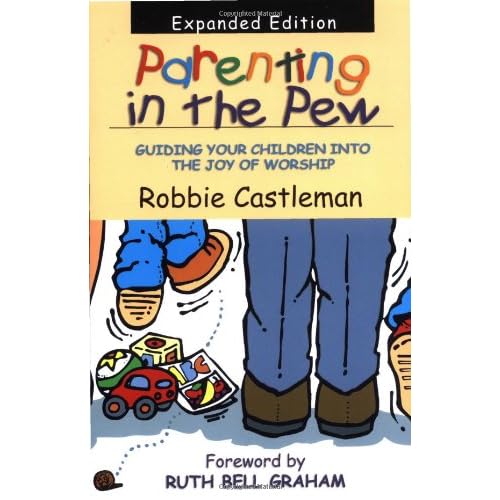
Children in gathered worship

There’s a lot of wisdom in this article by Jason Helopoulos on why children should worship with the rest of the church, a practice which the biblical authors seem to assume will be the case.

However, if anything I’d want to say I don’t think Jason goes far enough.  We shouldn’t just be content to get our children into and out of gathered worship without any loss of limbs and surely we’d want our children to be more than mere observers.  With some imagination and preparation we should be able to encourage even the youngest of children to interact and participate rather than resorting to mints and offering envelopes.

It may seem like mission impossible, but help is on hand.  A book we are currently reading through and that so far we’ve found to be full of great ideas on how parents can better nurture their children in this way is ‘Parenting in the Pew: Guiding your children into the joy of worship,’ by Robbie Castleman.

How to disciple a new believer

Discipleship is truth transferred through relationship.

That’s a helpful definition of discipleship.  However, lot’s of us might think ‘discipling’ is something for only ‘the professionals’ or church leaders to be involved in.

Here is a helpful article by Justin Buzzard to show how we can all be involved in making disciples of Jesus.

The Jesus Line

Here’s the next one of Tim Challies’ excellent Visual Theology creations – a visual genealogy from Adam through to Jesus.  You can find others here and here.

While printing this one out in a way that’s manageable might prove challenging, it is a great way of accessing (and even memorising?!?) this information.

What I particularly like about it is the way it’s been designed to look like an underground map.  The Jesus Line perhaps?

The inescapable logic of abortion – infanticide

Many Christians have been saying for a long time that there is no ethical difference between the killing of a child prior to or after birth and that both should be considered for what they in fact are, a violation against the 6th commandment – “You shall not murder.” (Exodus 20:13)

Now a paper published by two ethicisits in the British Medical Journal and highlighted online here and here, entitled “After-birth abortion: why should the baby live?” has called for the killing of newly born children to be made legal, on the basis that there is no ethical difference between this and abortion.  The abstract states,

 “After-birth abortion (killing a newborn) should be permissible in all cases where abortion is, including cases where the newborn is not disabled.”

The proposal is hideous, but the logic is inescapable. 

Heard the one about Jesus, Mohammed and the BBC?

You can read about Mark Thompson’s recent interview on the BBC and religious bias here, or if you want to see the whole interview yourself then head on over here.

If I’m hearing him right there’s a complete lack of logical consistency in Mr Thompson’s  explanation as to why it can be permissible to offend Christians but not Muslims in the UK

During his defence of why he thought it acceptable to show Jerry Springer: The Opera on the BBC he effectively makes the two following statements:

  • because Islam is a minority held view in the UK we need to take extra care we do not cause offence
  • because Evangelical Christianity as expressed by the group ‘Christian Voice’ is a minority held view in the UK we need not pay too much attention if offence is caused

Go figure!  Romans 1:21-22

So what is the right way to listen to a sermon?

With a soul that is prepared, a mind that is alert, a Bible that is open, a heart that is receptive, and a life that is ready to spring into action.

So says Phil Ryken in a helpful article you can find here.  And here’s a quote from Thabiti Anyabwile to remind you how to make your pastor’s day.

Few things are more discouraging or dishonoring to [faithful pastors] than a congregation inattentive to the Word of God. Faithful men flourish at the fertile reception of the preached Word. They’re made all the more bold when their people give ear to the Lord’s voice and give evidence of being shaped by it. As church members, we can care for our pastors and teacher and help to prevent unnecessary discouragement and fatigue by cultivating the habit of expositional listening.

Helping the poor – feeling or doing good?

Christianity Today addresses the issue of effective ways to fight poverty in it’s latest issue.  It highlights the problem that so often we give to feel good rather than to do good.  In the article, “Cost Effective Compassion: The 10 Most Popular Strategies for Helping the Poor,” economists specialising in analysing development programs were asked to rate from 0-10 some of the most common poverty interventions in terms of their impact and cost-effectiveness.

It’s an interesting list and worth at least a few minutes reflection as you sip your Fairtrade coffee – or perhaps not.

1. Get clean water to rural villages (Rating: 8.3)
2. Fund de-worming treatments for children (Rating: 7.8)
3. Provide mosquito nets (Rating: 7.3)
4. Sponsor a child (Rating: 6.9)
5. Give wood-burning stoves (Rating: 6.0)
6. Give a micro-finance loan (Rating 4.2)
7. Fund reparative surgeries (Rating: 3.9)
8. Donate a farm animal (Rating 3.8)
9. Drink fair-trade coffee (Rating. 1.9)
10. Give a kid a laptop (1.8)